
Low Earth orbit, 1996. A 12-mile ribbon of technology stretched into the void, meant to harvest energy from Earth’s magnetic field. The crew aboard Shuttle Columbia called it “the tether.” It was science in its purest form—until it snapped. What followed was broadcast live across the world: a free-floating filament of light, surrounded by hundreds of uninvited guests.
On February 25, 1996, during mission STS-75, the conducting tether experiment was deployed. At 19.7 kilometers extended, it snapped—cutting free, drifting like a luminous filament against the curve of Earth.
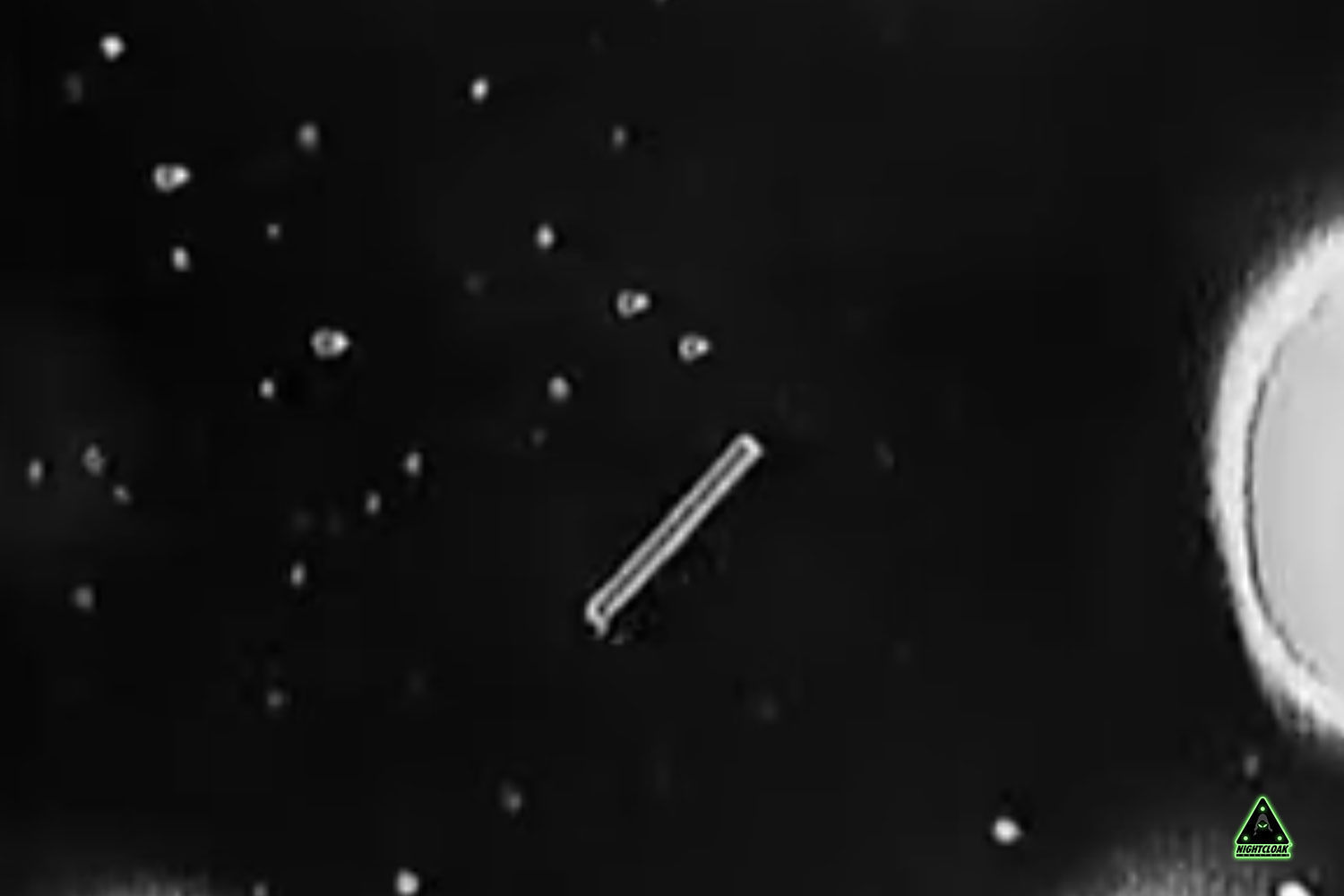
NASA’s infrared cameras captured what the eye could not dismiss. The tether glowed, and around it, disks appeared. Circular, translucent, some pulsing with light. They moved in front of and behind the tether—proof of depth, of scale. Some appeared hundreds of meters across, dwarfing the drifting experiment.
NASA called them ice, debris, “camera artifacts.” But witnesses worldwide, monitoring the live feed, recorded what they saw: hundreds of structured objects, moving as if alive.
NIGHTCLOAK INDUSTRIES
Case File: TETHER-96
Status: [DECLASSIFIED – LIMITED RELEASE]
Subject: Orbital Anomalies – STS-75 Mission
Date: February 25–March 1996
Location: Low Earth Orbit
____________________________
Summary
A 12-mile electrodynamic tether deployed by Shuttle Columbia broke free, drifting into orbit. Infrared video revealed hundreds of anomalies near the tether—circular, luminous, structured. Official explanations cite debris; evidence suggests otherwise.
____________________________
Incident Report
Event: Tether snapped ~19.7 km extended.
Recording: NASA IR and optical cameras captured anomalies.
Objects: Pulsating discs, often with central notches.
Scale: Some estimated >200 meters diameter.
Trajectory: Appeared to pass behind tether, inconsistent with ice particles.
Public Access: Incident broadcast live; later archived and analyzed worldwide.
____________________________
Observations
Objects displayed oscillation, pulsation, slow rotation.
Depth and layering evident—foreground and background relative to tether.
Movement not consistent with Newtonian drift or simple debris.
NASA downplayed findings, but global observers noted anomalies.
____________________________
Conclusion
CASE TETHER-96 remains one of the most well-documented orbital anomalies. Whether debris, plasma-based lifeforms, or structured craft, the incident demonstrates a mass multi-observer event beyond Earth’s atmosphere.
Assessment: Active anomaly. No recovery possible. Event unresolved.